


A startup founder attempting to open a business bank account faced unexpected delays when the bank requested formal authorization documentation. Without understanding “What is a Corporate Resolution,” she couldn't provide the required proof of authority. The account opening stalled for weeks.
A Corporate Resolution is a written statement created by a corporation's board of directors or LLC members documenting binding decisions. Eques Law explains that these formal documents serve as official records of significant business decisions.
Understanding when to use corporate resolutions helps businesses maintain proper documentation. Proper documentation through corporate resolutions demonstrates professional governance and supports accountability in business decision-making.

Key Takeaways
A corporate resolution is a formal written record of specific decisions made by a corporation’s board of directors or an LLC’s members or managers, separate from bylaws or operating agreements.
Banks, lenders, and other third parties often require resolutions to verify who is authorized to open accounts, sign contracts, or complete major transactions on behalf of the business.
Using resolutions consistently helps demonstrate good corporate governance, create clear approval trails, and support limited liability protections by showing the entity observes formal decision‑making procedures.
Common uses for resolutions include opening business bank accounts, approving loans or major purchases, authorizing officers or agents, and adopting changes to bylaws, operating agreements, or other governance structures.
Well-drafted resolutions clearly state the action being approved, identify the authorized individuals, include required signatures and dates, and are retained with company records to support audits, due diligence, and future reference.
What Is a Corporate Resolution?
A Corporate Resolution is a formal written record of decisions made by a corporation's board of directors or LLC members and managers—these documents detail binding corporate actions ranging from financial authorizations to operational changes. Formal business resolution documents create official records of who authorized specific actions and when decisions occurred.
Board resolution documents differ from governing documents like bylaws or operating agreements. Bylaws establish ongoing operational rules while resolutions document specific one-time decisions. Resolutions work within the framework established by governing documents rather than replacing them.
LLC resolutions serve similar purposes for limited liability companies. While LLCs are not legally required to adopt resolutions in most states, these documents are recommended to demonstrate proper corporate formalities and protect limited liability status. LLC resolution records help establish that the entity maintains appropriate decision-making procedures.
Why Corporate Resolutions Are Important
Corporate resolutions formalize decisions, document approvals, support compliance, and facilitate transactions. Board of directors approval through resolutions creates verifiable records showing proper authorization occurred. This documentation helps during audits, legal proceedings, or transaction reviews.
Legal entity compliance depends partly on maintaining proper records demonstrating that businesses follow required procedures. Good standing and compliance requirements include keeping appropriate documentation of major decisions. Resolutions help establish that decisions followed proper approval processes.
Corporate governance document practices reduce risks by creating clear accountability. When questions arise about who authorized actions, resolutions provide definitive answers. This clarity protects both businesses and individual decision-makers by establishing proper authorization trails.
When a Corporate Resolution Is Commonly Used
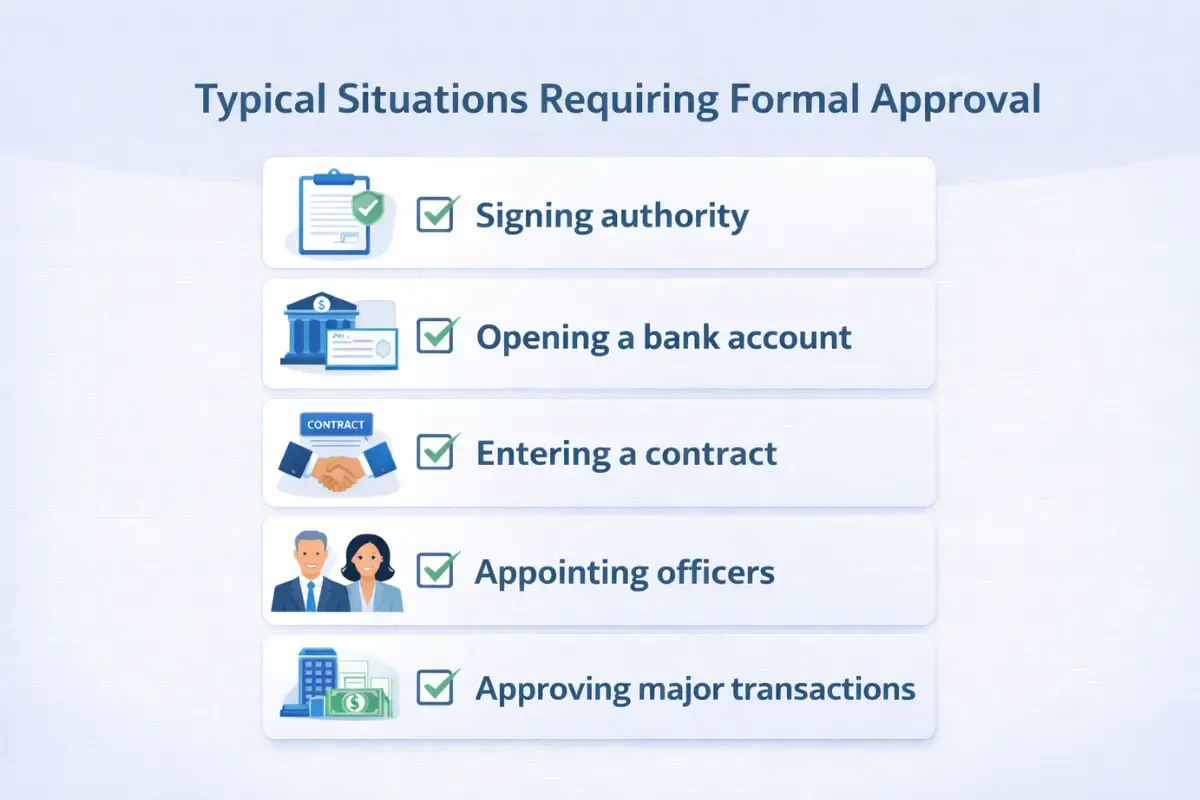
Standard business procedures trigger resolution creation. Corporate meeting resolutions typically address significant decisions affecting business operations or legal standing. Common situations include financial arrangements, structural changes, and authorization grants.
Business decision documentation through resolutions is used for actions requiring formal approval. Third parties often request resolutions as proof of proper authorization.
Opening a Bank Account
Financial institutions often require a corporate approval document confirming who is authorized to open accounts and sign on behalf of businesses. Banks need verification that account signatories possess proper authority from corporations or LLCs. This standard practice applies to both new account openings and signatory changes.
Authorized signature requirements are documented in banking resolutions that identify specific individuals. Resolutions typically name officers, members, or managers authorized to conduct banking transactions. Banks retain these resolutions in account files as proof of ongoing authorization.
Corporate banking resolutions protect all parties by establishing clear authorization. Banks rely on these documents when processing transactions or responding to signature verification requests. Proper documentation helps prevent unauthorized access to accounts or fraudulent transactions.
Approving Major Business Transactions
Corporate resolutions may record approval of significant financial decisions, such as taking on loans, purchasing assets, or entering into contracts. Business entity internal controls often require board or member approval before committing to substantial obligations. Resolutions formalize these approvals.
Major transaction thresholds vary by company size and governing documents. Some businesses require resolutions for any transaction exceeding specific dollar amounts. Others mandate resolutions for particular transaction types regardless of size.
Resolutions provide formal records without implying legal guidance about whether transactions should occur. Professional advisors help determine the appropriateness of transactions, while resolutions simply document authorization once decisions are made.
Authorizing Officers or Agents
Resolutions formally designate individuals, such as officers, managers, or agents, to act on behalf of companies for specific tasks. These authorization documents specify what actions designated individuals can perform. Modern LLC management often includes formal authorization procedures for key roles.
Meeting minutes documentation accompanies authorization resolutions by recording discussions and votes. Together, minutes and resolutions create complete records of authorization decisions. This documentation ensures accountability in business operations.
Authorization resolutions clarify roles but do not provide personalized delegation advice. Businesses determine appropriate delegation strategies, while resolutions simply formalize whatever authorization decisions are made.
Changing Corporate or LLC Details
Resolutions may document approvals for amendments to bylaws, operating agreements, or other internal governance changes. Structural modifications typically require formal approval from boards or members, depending on the entity type and the governing document's provisions.
Corporate record retention systems maintain resolution records alongside amended governing documents. This creates historical trails showing when and why changes occurred. Proper documentation supports compliance with organizational procedures.
Resolutions serve as formal records supporting governance changes without constituting recommendations about specific amendments. Professional advisors help determine appropriate structural modifications, while resolutions document final approval decisions.
How to Draft a Corporate Resolution
Best practices for board resolutions emphasize clarity, completeness, and procedural accuracy. Resolution template example documents and corporate resolution template resources provide starting points but require customization. Professional consultation helps with complex situations.
General drafting guidance includes key elements without providing personalized legal advice. Businesses adapt principles to their circumstances and to requirements under their governing documents.

Title and Heading
Resolutions should begin with a clear title that identifies their purpose, such as "Resolution to Open Bank Account" or "Resolution Authorizing Loan." Descriptive titles help quickly identify resolutions in company records and ensure proper filing.
Specific, descriptive titles prove particularly valuable when businesses accumulate multiple resolutions over time. Clear identification enables rapid access to relevant authorization documents when needed for transactions or audits.
Statement of Action
This section records specific decisions or approvals made by boards, members, or managers. Writing action statements requires precise, neutral language clearly outlining actions without interpretation.
Action statements avoid ambiguous language that could create uncertainty about what was authorized. Specific, concrete descriptions ensure all parties understand exactly what decisions were made. This precision prevents future disputes about authorization scope.
Authorized Signatures
Resolutions must include signatures of authorized individuals such as board members, LLC managers, or company officers. Signatures validate resolutions and create verifiable approval records. Multiple entity management becomes more complex, but signature requirements remain consistent.
Signature requirements vary based on entity type and governing documents. Some decisions require unanimous approval, while others need simple majorities. Governing documents specify required signature thresholds for different decision types.
Date and Documentation
Including resolution dates and records when decisions were formally approved. Dates establish authorization timelines, important for transaction sequencing and compliance tracking. Resolutions should be properly stored with company records supporting accountability and compliance.
Corporate recordkeeping systems maintain resolutions alongside other corporate documents. Business record-keeping practices and what is a corporate seal documentation together support comprehensive governance records. Both digital and physical storage work, provided records remain accessible and protected.
How Professional Support Can Help
Professional advisors assist with the preparation, organization, and management of corporate resolutions and governance records. Services help ensure accurate recordkeeping and procedural compliance without providing legal advice.
Professional support benefits include time savings and reduced risk of errors. Complex situations may still require consultation with a licensed attorney. Contact InCorp to explore how professional compliance support helps businesses manage documentation requirements.
Next Steps for Managing Corporate Decisions
Corporate resolutions maintain organized business records, document decisions, and support procedural compliance. These standard business practices provide clarity and accountability for corporations and LLCs. Proper resolution documentation demonstrates professional management.
Resolution requirements vary by entity type, state, and governing documents. Businesses benefit from understanding their specific obligations and maintaining consistent documentation practices. Professional guidance helps navigate complex situations.
Systematic resolution practices support long-term business success through clear authorization trails and compliance documentation. Organized record systems facilitate smooth operations and transaction processing.
FAQs
Disclaimer
This content is intended for general educational and informational purposes only and does not constitute legal, tax, or accounting advice. Every effort is made to keep the information current and accurate; however, laws, regulations, and guidance can change, and no representation or warranty is given that the content is complete, up to date, or suitable for any particular situation. You should not rely on this material as a substitute for advice from a qualified professional who can consider your specific facts and objectives before you make decisions or take action.
Stay Informed!
Sign up to receive important updates, helpful resources, and special offers.