


When a business entity is served with a lawsuit or receives a state compliance notice, the first thing that matters is proper delivery and notice. For corporations, LLCs, LPs, and LLPs, state law requires maintaining a registered agent at all times to receive service of process, specific tax notices, and other critical government correspondence. Registered agent isn’t just a formality; it’s your first line of defense against missed deadlines and default judgments because it ensures you’re officially and promptly notified.
The good news? Appointing your agent is a straightforward process when you understand the rules. This guide offers a clear, ten-step roadmap to help your business stay compliant from day one. Appointing a registered agent is essential to maintain compliance with state regulations.
Introduction to Registered Agents
A registered agent is the official point of contact between your company and the state. This means having a reliable person or service in place to receive service of process (SOP), legal notices, and other important documents on your behalf and promptly forward and notify you. The role is about ensuring your business never misses a critical communication—especially with legal matters or lawsuits—so you can respond on time.
By serving as your company’s official point of contact, registered agents help reduce the risk of missed legal notices and maintain a reliable channel for state communications.
Key Takeaways
Mandatory Requirement: A registered agent is a non-negotiable compliance requirement for every type of formal business entity in every U.S. state.
Defined Process: An appointment typically occurs during your entity formation filing or via a separate form for existing businesses.
Eligibility Rules: Your chosen agent must have a physical street address within the state and be available during all standard business hours.
Agent Consent/Acceptance (varies by state): Some states require the agent’s signed acceptance (e.g., Florida, Arizona, Nevada). Others allow you to list the agent without a separate consent filing (e.g., Delaware). Check your state’s form instructions.
Professional Services Simplify Compliance: A national provider like InCorp delivers reliable coverage, handles state-specific filings, and streamlines multi-state operations.
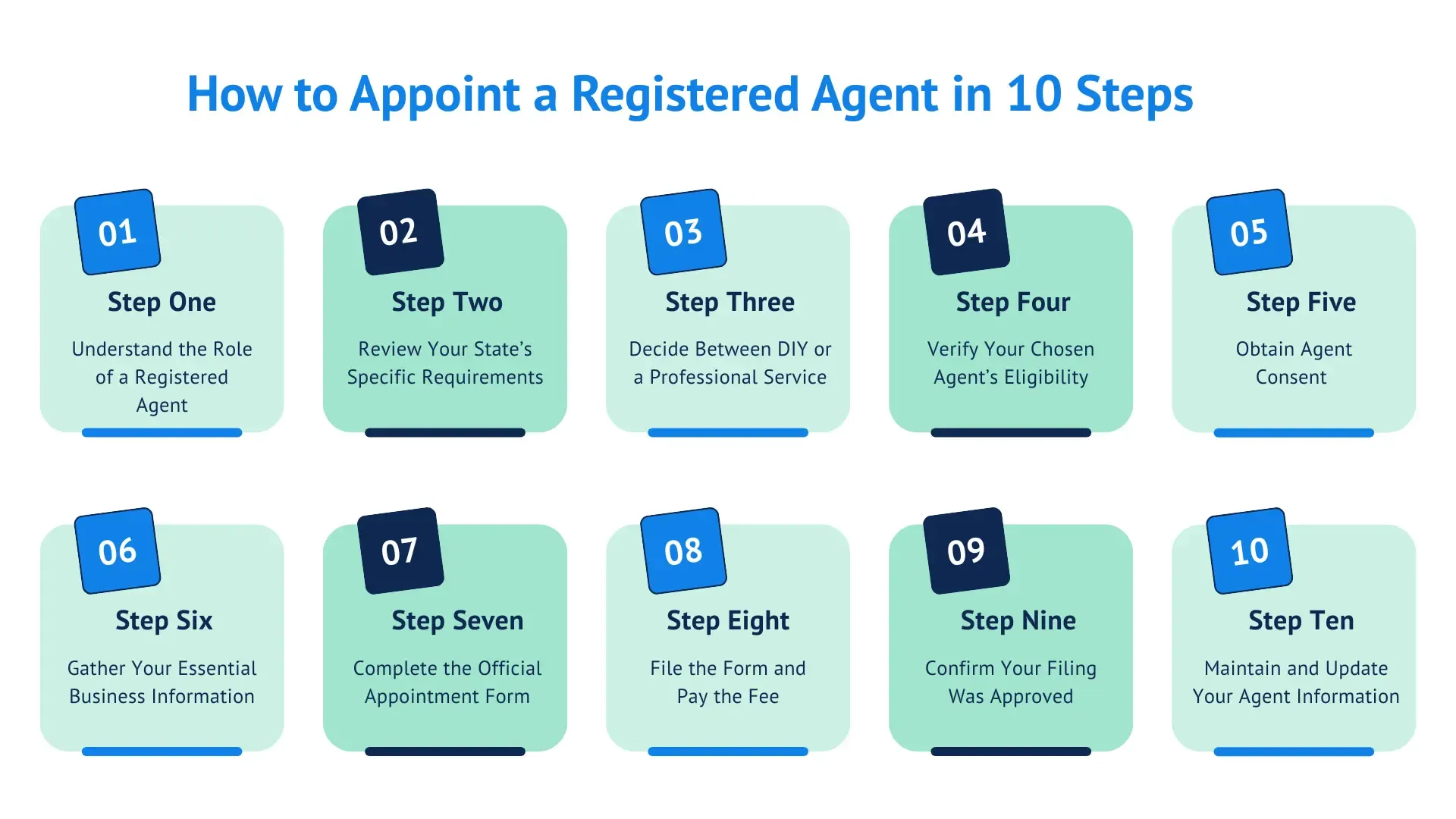
Step 1: Understand the Role of a Registered Agent
Before you appoint one, understand what a registered agent does. This person or business service is officially designated to receive service of process (lawsuits, subpoenas) and certain state notices on your company’s behalf and promptly forward them to you. As Business.com notes, “A registered agent is an individual or business that acts as a state’s means of communicating with a corporation or limited liability company (LLC).”
Think of them as your business’s official point of contact with the state—a designated, in-state address that’s available during normal business hours to accept lawsuits and government notices, provide proof of delivery, and promptly forward them to you so you can respond on time. Using a registered agent also helps keep your personal address off public records and ensures continuity if your business moves or expands into other states. This role is sometimes called a statutory agent or resident agent, depending on the state, but the core duties—maintaining a physical address, accepting official documents, and forwarding timely notices—are similar across corporations, LLCs, LPs, and LLPs.
Step 2: Review Your State’s Specific Requirements
While the core function of a registered/statutory agent is consistent, state rules vary. Most states require that the agent:
Be eligible in-state: Either (a) an individual who is a resident of the state (often 18+) or (b) a business entity authorized/registered in the state and permitted to act as a registered agent (often listed as a “commercial registered agent”).
Maintain a physical street address in that state (the “registered office”): P.O. boxes alone don’t satisfy the requirement. The address must be in the state where your company is formed or qualified, not merely where you operate.
Be available during regular business hours: State law typically says “regular business hours” rather than a specific 9–5; think Monday–Friday, non-holiday days.
Step 3: Decide Between an Individual or a Professional Service
Businesses have two primary options for a registered agent. A thorough registered agent comparison between these options will help you choose:
Individual (Yourself, an Employee, or a Trusted Contact)
Pros: Low cost (often free); you control the address.
Cons: The address becomes public, requiring reliable availability at that in-state address during regular business hours. Additionally, there are coverage gaps if the person is out sick/on vacation. If the address changes, you must update the state promptly.
Business owners may serve as their entity’s registered agent if they meet state requirements (in-state physical address, availability). Using a home address reduces privacy because it requires listing a personal address on public records. Using a staffed business office can be effective if it meets all the requirements.
Professional Registered Agent Service (e.g., InCorp)
Pros: Protects privacy by using the provider’s address; satisfies in-state availability requirements; provides a single point of contact for multi-state operations; typically offers document scanning, tracking, and deadline reminders; ensures continuity if you move or expand.
Cons: Recurring annual fee (commonly in the $100–$300 range, varies by provider and term length).
As outlined by Forbes, “You can hire a registered agent service for an annual fee or select a registered agent service when you register your business with an LLC service. This can solve many of the problems that listing yourself as your registered agent could pose.”

Step 4: Verify Your Chosen Agent’s Eligibility
Once you’ve decided, confirm your choice meets your state’s rules. In all states, your registered agent must be legally capable of accepting service of process and meet these general requirements:
If an individual: a natural person who is a resident of the state and of the legal age of majority (usually 18), with capacity to accept service.
If a business entity: authorized/registered to do business in the state and permitted to act as a registered agent (in some states, this means a listed commercial registered agent).
Registered office: a physical street address in the state (no P.O. boxes) where the agent can be reached.
Availability: present at that address during business hours.
Step 5: Obtain Agent Consent (State Rules Vary)
States handle consent differently. Some require the registered/statutory agent to formally accept the appointment(e.g., by signing the filing or a separate acceptance form). Others don’t require a separate consent filing, but the agent must still be willing and able to serve.
Professional service: Consent/acceptance is typically built into the signup process.
Individual agent: If your state requires it, obtain a signed consent/acceptance and keep it with your records.
Best practice (all states): Get written confirmation from the agent and follow your Secretary of State’s form instructions to ensure the appointment is valid.
Step 6: Gather Your Essential Business Information
Before you file, have the following ready to complete state forms accurately (and avoid delays):
Business legal name (exactly as it will appear on the filing).
Business ID/Control number (if already formed or foreign-qualified).
Registered agent’s name and in-state physical address (no P.O. boxes).
Pro tip: Double-check spellings and addresses against your state’s records. Minor errors are a common cause of processing delays.
Step 7: Complete the Official Appointment Form
New businesses: Appoint your registered agent in your formation filing (e.g., Articles of Organization/Incorporation) by listing the agent’s legal name and in-state street address. Some states also require the agent’s acceptance/consent or selection of a commercial registered agent from a state list.
Existing businesses: File your state’s Change of Registered Agent/Registered Office form (name varies) with the filing office (often the Secretary of State). Many states allow you to update both the agent and address on a single form.
If you use an online registered agent service, the provider will often submit the appointment or change for you in many states once you authorize and pay. In other states, they’ll provide the agent details and any required consent so your formation service—or you—can file with the state. (Note: companies like InCorp also offer business formation services, so you can handle both formation and registered agent in one workflow without relaying info.) Follow the provider’s workflow for signatures, fees, and filing method.
Step 8: File the Form and Pay the Fee
Submit your completed filing and the required state fee to the appropriate agency (usually the Secretary of State). Most states let you file online, by mail, or in person.
State fees: Vary by state and filing type. An initial appointment is typically included in formation fees; changing a registered agent often has a separate fee. Expedited processing, if available, costs extra.
Registered agent fees: Charged annually by your provider and are separate from state fees.
Payment methods: Depend on the state (standard options include credit/debit card online, ACH, or check/money order by mail).
Pro tip: Review your provider’s invoice and the state’s fee schedule so you’re clear on two distinct costs—the provider’s annual service fee and the state’s filing/expedite fees.
Step 9: Confirm Your Filing Was Approved
After submission, the state will issue proof of approval—typically a stamped/approved copy of your formation filing or an approval notice for a registered agent change. Save this in your permanent records.
Pro tip: Check your listing in the Secretary of State’s online database to verify the registered agent on record and note the effective date. If the filing is rejected or returned for correction, follow the state’s instructions, fix the issue, and resubmit.
Experienced providers like InCorp prepare filings to meet state-specific requirements, which reduces the likelihood of avoidable rejections and speeds up corrections if the state requests changes.
Step 10: Maintain and Update Your Agent Information
It is the company’s legal obligation to maintain a registered agent and current registered office on file at all times. If your agent resigns or changes address, you must ensure an update is filed with the state within the required timeframe(often about 30 days) to avoid lapses in representation.
To prevent gaps, appoint your new agent before the old one resigns. As you expand into other states through foreign qualification, you must appoint a registered agent in each state. Failure to maintain a valid agent/office can lead to missed notices, loss of good standing, penalties, or administrative dissolution.
National Registered Agent Service
For business owners expanding into multiple states, a national registered agent service streamlines compliance across jurisdictions. Instead of managing separate local agents, you get a single point of contact with centralized document receipt, logging, tracking, and timely forwarding—plus state-specific guidance when requirements differ.
Companies like InCorp provide experienced teams and nationwide coverage, helping you maintain continuous representation, meet in-state availability rules, and reduce the risk of missed notices or avoidable filing issues as you grow. With a national provider, you can expand confidently while managing registered agent obligations for all states from one account.
FAQs
Disclaimer
This content is intended for general educational and informational purposes only and does not constitute legal, tax, or accounting advice. Every effort is made to keep the information current and accurate; however, laws, regulations, and guidance can change, and no representation or warranty is given that the content is complete, up to date, or suitable for any particular situation. You should not rely on this material as a substitute for advice from a qualified professional who can consider your specific facts and objectives before you make decisions or take action.
Stay Informed!
Sign up to receive important updates, helpful resources, and special offers.