


An aspiring entrepreneur wants to start a business online selling handmade products. A freelance consultant plans to offer services through a professional website. A content creator seeks to monetize digital courses. Each scenario requires understanding the online business legal requirements and operational steps for successful online ventures.
Learning how to start a business online involves understanding business models, completing legal registration, establishing technical infrastructure, and maintaining ongoing compliance. The steps to launch an online business cover strategic planning, entity formation, website development, and marketing implementation.
This online business startup checklist guides aspiring entrepreneurs through selecting business models, registering, setting up technical systems, and complying with the obligations required to operate online businesses successfully.
InCorp is not a law firm and does not provide legal or financial advice. This information is educational. Readers should consult with qualified legal professionals.
Key Takeaways
Choose your business model carefully – E-commerce, service-based, and digital product businesses each have distinct operational requirements, scaling potential, and compliance obligations that affect your long-term success.
Select the right business structure – LLCs and corporations provide personal liability protection that shields your personal assets from business debts, while sole proprietorships offer no separation between you and your business.
Complete essential registrations – Register your business with your state, obtain an EIN from the IRS, secure necessary licenses and permits, and register for sales tax in states where you have nexus.
Build a professional online presence – Invest in a quality website with a matching domain name, mobile optimization, and secure payment processing to establish credibility and facilitate transactions.
Maintain ongoing compliance – File annual reports on time, maintain a registered agent in states where required, and keep business and personal finances separate to preserve liability protection and good standing status.
Budget for startup costs – Plan for expenses including domain registration, website hosting, business formation fees, payment processing charges, licenses, and marketing investments to launch successfully.
Develop a multi-channel marketing strategy – Combine SEO, social media, email marketing, and paid advertising to reach your target audience and drive initial traffic after launch.
Avoid common mistakes – Don't skip business registration, mix personal and business finances, operate with unregistered names, or overlook tax obligations, as these errors create legal vulnerabilities and operational risks.
Choosing the Right Online Business Model
Business model selection affects operational requirements, revenue potential, and compliance obligations.
E-commerce Businesses
E-commerce businesses sell physical or digital products through owned websites or third-party marketplaces. This model requires managing inventory, fulfillment processes, sales tax obligations, and customer transactions.
Online Service-Based Businesses
Service-based online businesses deliver professional services remotely, including freelancing, consulting, coaching, or agency work. This model requires minimal physical infrastructure but depends on expertise, time availability, and client relationships.
Operational factors include client contracts that define scope and payment terms, invoicing systems for billing and payment tracking, and business licensing requirements that vary by service type.
Service businesses scale differently from product businesses because growth typically requires hiring additional service providers or building scalable service-delivery systems.
Digital Products and Subscriptions
Digital products and subscription models include courses, software, memberships, or downloadable content delivered electronically. This model offers high profit margins since digital products incur minimal per-unit costs after initial creation.
Considerations include intellectual property protection for original content, recurring revenue models requiring ongoing customer value delivery, and ongoing customer access or support infrastructure. Subscription businesses benefit from predictable revenue but require continuous content or service updates to maintain subscriber engagement.
Digital product businesses scale efficiently because additional sales incur minimal incremental costs, unlike physical products or services that require direct time investment.
Step-by-Step Guide to Starting an Online Business
The steps to launch an online business follow systematic processes from initial planning through operational launch.
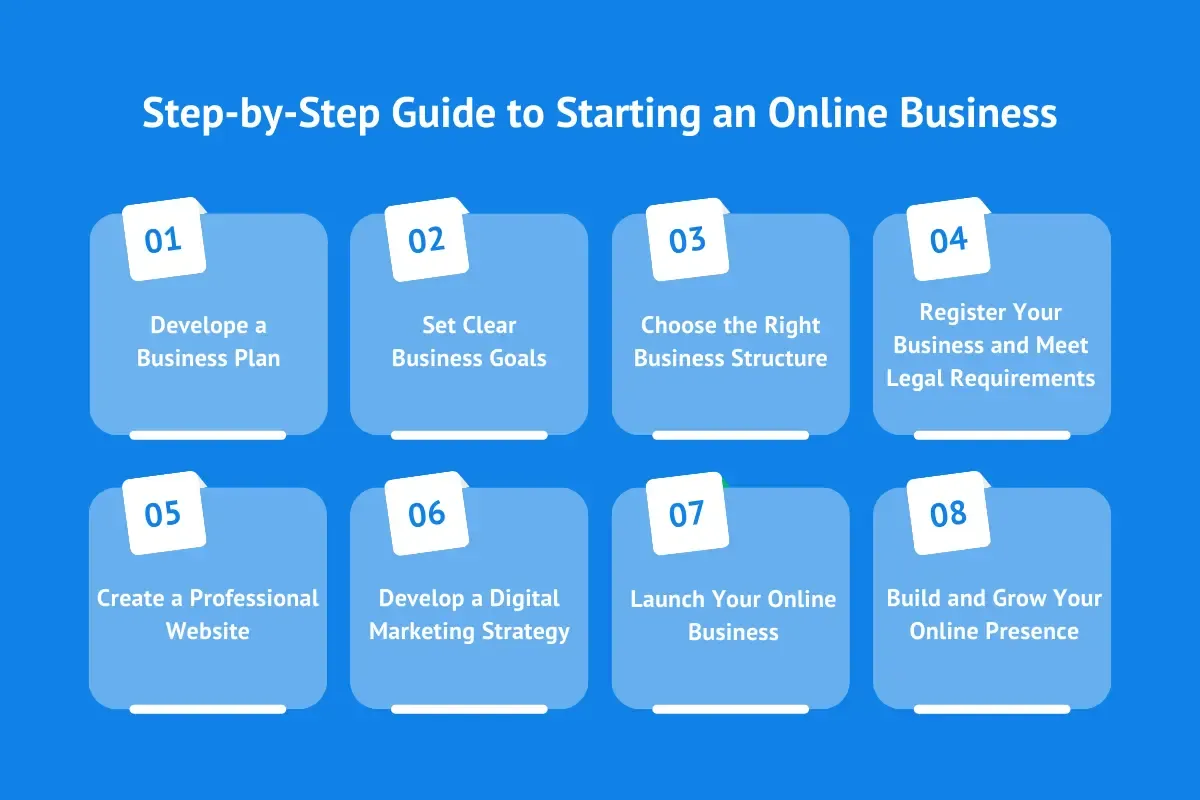
Step 1 – Develop a Business Plan
A business plan outlines business ideas, products or services, target audiences, revenue models, and marketing approaches. Plans help guide operational decisions and support future growth or funding needs.
Formal business plan documents prove valuable when seeking funding from investors or lenders. Even businesses that do not require external funding benefit from written plans that clarify objectives and strategies.
Step 2 – Set Clear Business Goals
Breaking goals into short-term and long-term objectives creates measurable milestones for tracking progress. Short-term goals might include launching websites or securing first customers, while long-term goals could involve scaling operations or achieving specific revenue targets.
Tracking progress through metrics helps businesses adjust plans as markets and circumstances evolve. Regular goal reviews ensure businesses remain focused on priority objectives while remaining flexible to opportunities or challenges.
Step 3 – Choose the Right Business Structure
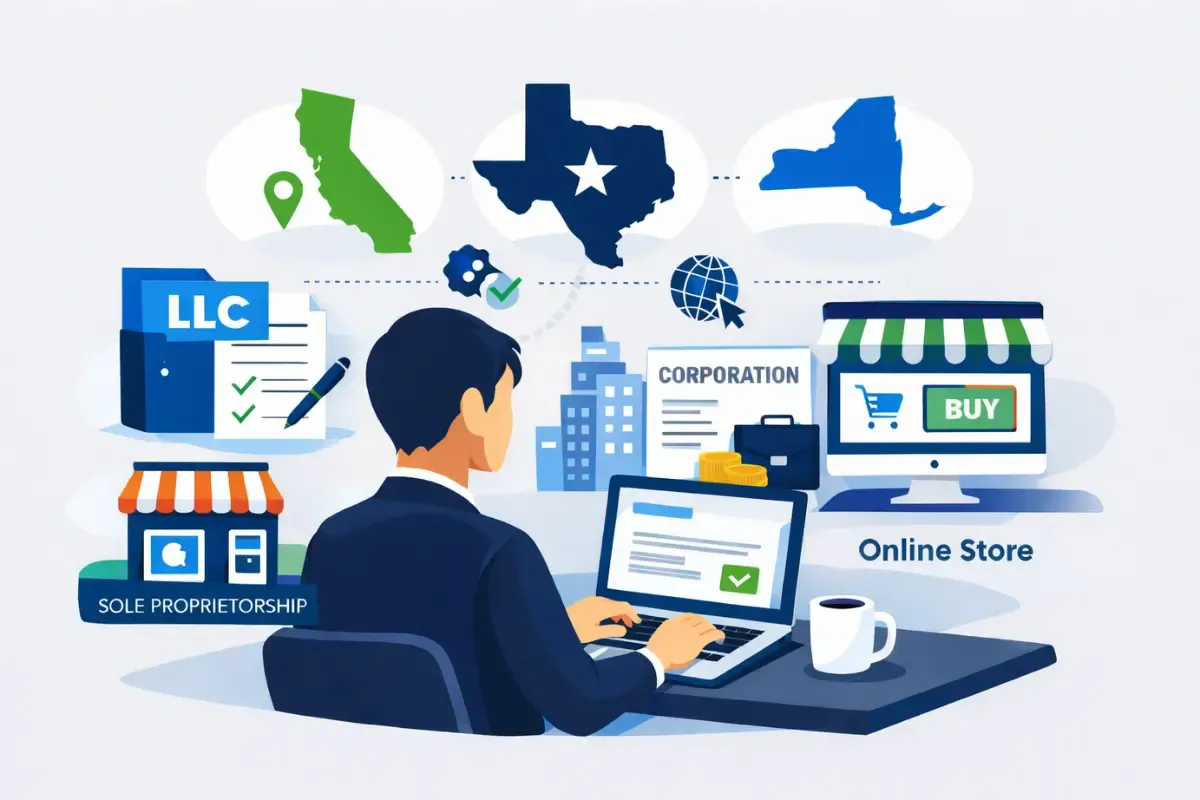
Common structures include sole proprietorships, LLCs, and corporations. Structure selection affects liability protection, taxation treatment, and compliance requirements.
A sole proprietorship is the simplest business structure, where the owner and the business are a single entity. This structure offers no personal liability protection, meaning business debts become personal obligations.
LLC formation creates a separate legal entity that provides personal liability protection while maintaining operational flexibility. LLCs typically face fewer governance requirements than corporations while still shielding owners' personal assets from business liabilities.
Corporations provide strong liability protection and facilitate raising capital but require formal governance.
Step 4 – Register Your Business and Meet Legal Requirements
Business registration involves filing formation documents with state or local agencies and obtaining required licenses or permits. Requirements vary by location, business structure, and industry.
State business registration typically occurs through Secretary of State offices or equivalent agencies. Filing fees range from approximately $50 to several hundred dollars, depending on jurisdiction and entity type.
Industry-specific licensing applies to regulated sectors including food service, healthcare, financial services, and professional services. Business licensing requirements vary substantially by industry and location.
Step 5 – Create a Professional Website
Websites serve as the foundation for online businesses, providing platforms to present products or services, process transactions, and communicate with customers. Professional websites require usability, mobile optimization, and clear presentation of offerings.
Domain registration establishes unique web addresses identifying businesses online. Domain names should align with business names or brands for easy customer recognition and recall.
Website platforms range from content management systems that offer extensive customization to website builders that provide simplified setup. Platform selection depends on technical expertise, customization needs, and budget constraints.
Step 6 – Develop a Digital Marketing Strategy
Marketing channels include search engine optimization, social media marketing, email marketing, and paid advertising. Testing and refining strategies help identify the most effective approaches for reaching target audiences.
Search engine optimization improves website visibility through keyword optimization and quality content. Social media marketing builds brand awareness through platform-specific content.
Email marketing enables direct communication with customers and prospects through newsletters, promotional offers, and the delivery of valuable content. Paid advertising provides immediate visibility across platforms, including Google Ads and social media.
Step 7 – Launch Your Online Business
The launch phase makes websites live and initiates marketing efforts. Monitoring early performance and customer feedback helps identify needed adjustments and opportunities for improvement.
Soft launches to limited audiences allow testing systems before full public launches. This approach helps identify technical issues or operational challenges in controlled environments.
Launch announcements through email lists, social media, and other marketing channels drive initial traffic and customer acquisition. Early customer experiences significantly influence a company's long-term reputation and growth potential.
Step 8 – Build and Grow Your Online Presence
Social media marketing and consistent branding support long-term growth through audience engagement and visibility. Building online presence requires regular content creation, customer interaction, and brand consistency across channels.
Long-term growth strategies include expanding product or service offerings, entering new markets, and developing additional revenue streams. Sustainable growth balances customer acquisition with operational capacity and quality maintenance.
How to Register Your Online Business
Register a business online by systematically completing the naming, tax identification, and licensing requirements. Registration establishes legal business entities authorized to conduct commercial activities.
Choose a Business Name
Business names should reflect the brand and be easy to recognize. Checking name availability through state business registries confirms names remain available for registration.
USPTO database searches identify potential trademark conflicts that could create legal issues later. Securing matching domain names for chosen business names maintains consistent online branding.
Obtain an Employer Identification Number (EIN)
An EIN functions as a tax ID number for federal tax purposes. EINs are commonly required to open business bank accounts, hire employees, and file tax returns.
The IRS issues EINs through online applications for immediate issuance or mail applications processing within several weeks. EIN applications require basic business information, including structure type, ownership details, and business addresses.
Register for Taxes
Online businesses may need federal, state, or local tax registrations depending on activities and locations. Common registrations include income tax and sales tax permits.
Sales tax obligations arise when businesses establish nexus in states through physical presence or economic activity thresholds. Economic nexus rules require sales tax collection when businesses exceed state-specific revenue or transaction thresholds.
Apply for Required Licenses and Permits
Some online businesses require industry-specific or local licenses to operate legally. Business licensing requirements vary by state, city, and industry.
Checking state and local agency requirements before launching prevents compliance violations and operational delays. License applications typically require business registration documentation and may involve inspection processes.
Setting Up the Technical Essentials
Foundational technical elements enable professional and legal online business operations. These essentials support customer transactions, brand identity, and operational efficiency.
Domain Name and Website
Domain registration creates unique web addresses supporting branding, credibility, and business control. Domains serve as digital addresses that direct customers to business websites.
Websites serve as operational hubs facilitating sales, service delivery, and customer communication. Professional websites require secure hosting, intuitive navigation, and mobile responsiveness.
Online store setup for e-commerce businesses includes product catalogs, shopping carts, and checkout systems. E-commerce platform selection affects available features, customization options, and transaction processing capabilities.
Payment Processing and Banking
Separating personal and business finances through business bank accounts supports record-keeping and business compliance. Payment processing systems enable customer transactions via credit and debit cards and digital payment methods.
Payment processing services charge transaction fees typically ranging from 2–3 percent plus fixed per-transaction amounts. Comparing processor fees, features, and integration options helps identify optimal solutions.
Ongoing Compliance for Online Businesses
Business compliance obligations continue after formation. Maintaining compliance preserves good standing status and prevents penalties or operational disruptions.
Annual Reports and State Filings
Many states require periodic filings to maintain good standing after formation. Deadlines and requirements vary by state and business structure.
Annual reports typically require updated business information, including addresses, officers, and registered agents. Filing fees accompany most annual reports, with amounts varying by jurisdiction.
Missing filing deadlines results in penalties, late fees, and potential administrative dissolution. Maintaining filing calendars prevents compliance lapses that could jeopardize business operations.
Registered Agent Requirements
Registered agents receive legal notices and state correspondence on behalf of businesses. Most states require registered agents for LLCs and corporations.
Registered agents must maintain a physical address in each state of formation and remain available during business hours. Professional registered agent services ensure reliable receipt and forwarding of documents.
Common Mistakes When Starting a Business Online
Frequent missteps include skipping business registration, mixing personal and business finances, using unregistered business names, or overlooking tax and compliance requirements.
Skipping registration eliminates liability protection and creates legal vulnerabilities. Operating unregistered businesses can result in fines, cease-and-desist orders, and personal liability for business obligations.
Mixing finances complicates accounting, tax preparation, and financial analysis. Separate accounts are essential for accurate record-keeping, maintaining corporate formalities, and supporting liability protection.
Overlooking compliance requirements creates legal problems. Proactive compliance prevents penalties.
How InCorp Helps Entrepreneurs Start Businesses Online
InCorp supports online business owners with entity formation, registered agent services, EIN assistance, and ongoing compliance filings. Professional support helps businesses stay organized and compliant throughout the startup and growth phases.
Formation services handle document preparation, state filing, and initial setup tasks. Registered agent services provide reliable receipt and forwarding of legal documents. EIN assistance streamlines federal tax identification processes.
InCorp functions as a reliable long-term partner helping businesses maintain compliance as they grow. Administrative support frees entrepreneurs to focus on business operations and customer service.
Staying Compliant as Your Online Business Grows with InCorp
As online businesses expand, business compliance responsibilities, including annual reports, registered agent services, and state filings, become increasingly important. InCorp helps business owners efficiently manage ongoing compliance requirements.
Compliance management supports long-term growth without disrupting daily operations. Professional services track filing deadlines, maintain registered agent coverage, and handle administrative requirements across multiple jurisdictions.
Explore InCorp's business formation and compliance services to support entrepreneurs starting a business online with confidence in their legal and administrative foundations.
FAQs
Disclaimer
This content is intended for general educational and informational purposes only and does not constitute legal, tax, or accounting advice. Every effort is made to keep the information current and accurate; however, laws, regulations, and guidance can change, and no representation or warranty is given that the content is complete, up to date, or suitable for any particular situation. You should not rely on this material as a substitute for advice from a qualified professional who can consider your specific facts and objectives before you make decisions or take action.
Stay Informed!
Sign up to receive important updates, helpful resources, and special offers.