


You've spent months perfecting your business idea, researching your market, and building your product. Now you're ready to make it official—but suddenly, you're drowning in confusing terms like "registered agent," "incorporation service," and "business formation." You keep seeing these services mentioned together, and you're not sure if you need one, both, or if they're even the same thing. Sound familiar?
This confusion is completely normal. Most entrepreneurs hit this wall when transitioning from an idea to a legitimate business entity. The problem is that while registered agents and incorporation services are both integral to business formation and compliance, they serve completely distinct functions that can make or break your business's legal standing.
Getting this wrong isn't just inconvenient—it can result in missed legal deadlines, compliance penalties, or problems maintaining your business license. But the good news is that once you understand the differences, choosing the right services becomes straightforward.
Understanding when you need a registered agent service versus an incorporation service ensures your business starts on solid legal ground while maintaining ongoing compliance with state regulations. In this article, we'll break down exactly what each service does, when you need them, and how to make the right choice for your business.
What is a Registered Agent?
A registered agent is an individual or organization appointed to accept legal papers, government communications, and compliance notices for a business. You can think of them as a designated official address for your company's important messages.
This isn't just a convenience—it's a legal requirement. According to the U.S. Small Business Administration, "If your business is an LLC, corporation, partnership, or nonprofit corporation, you'll need a registered agent in your state before you file. A registered agent receives official papers and legal documents on behalf of your company."
The registered agent must maintain a physical address within the state where your business is incorporated and be available during normal business hours to receive important documents. This includes everything from annual report reminders to legal papers if your business faces a lawsuit.
The registered agent's name and address are recorded with the state and become part of the public record. Your company's registered agent serves as a crucial buffer between your business and government agencies or other legal entities. Having a dependable registered agent ensures you never miss time-sensitive legal or compliance notifications, helping protect you and your business.
What is an Incorporation Service?
An incorporation service is a company that assists entrepreneurs in legally forming their business entities. They handle the preparation of all necessary documents and file them with your state's business authority, typically the Secretary of State. This is broadly known as incorporation. A good incorporation service will act as your knowledgeable guide, helping you navigate the complex business formation process.
Legal experts emphasize why incorporation matters so much for business owners. According to business attorneys at Askin & Hooker Attorneys at Law, "The most important strategy for protecting your personal and business assets is to structure your business as a separate legal entity... In the eyes of the law, a legally established LLC becomes a separate entity, keeping business assets separate from personal assets."
Rather than wrestling with unfamiliar state forms and filing instructions, an incorporation service eliminates the guesswork. They handle everything from preparing your articles of organization (for LLCs) or articles of incorporation (for corporations) to obtaining your Federal Employer Identification Number (EIN).
Most incorporation services can also assist with additional business documents like operating agreements for LLCs, corporate bylaws, and other corporate filings. Many also offer pre-filled forms, same-day document delivery, and client portal access, where you can track your formation progress and access critical documents. Some services even include business email setup to help establish your professional presence from day one.
Registered Agent vs. Incorporation Service Comparison
Compare key features and differences between these essential business services
| Category | Registered Agent Services | Incorporation Services |
|---|---|---|
|
Primary Role
|
Legal point of contact for service of process and state notices | Helps form your business entity and file official paperwork |
|
Legal Requirement
|
Required for LLCs, corporations, and nonprofits in all 50 states | Optional, but simplifies and expedites business formation |
|
Duration of Service
|
Ongoing throughout the life of the business | Primarily during startup; some provide post-formation support |
|
Main Responsibilities
|
Receives legal documents, compliance notices, annual report reminders | Prepares and files Articles of Organization/Incorporation and EIN applications |
|
Privacy Protection
|
Uses their address to keep your personal address off public records | May not protect your address unless bundled with registered agent service |
|
Cost Structure
|
Annual fee (typically $100–$300/year) | One-time fee (typically $50–$500 + state fees); may offer tiered or bundled packages |
|
Availability
|
Must be available during business hours to receive legal notices | Not required to be continuously available |
|
Location Requirements
|
Must have a physical address in each state where business is registered | Assists with filing in the state of formation |
|
Use Case Example
|
Needed for ongoing legal compliance and reliable receipt of service of process | Ideal for new entrepreneurs unfamiliar with state filing requirements |
Primary Role
Registered Agent Services
Legal point of contact for service of process and state notices
Incorporation Services
Helps form your business entity and file official paperwork
Legal Requirement
Registered Agent Services
Required for LLCs, corporations, and nonprofits in all 50 states
Incorporation Services
Optional, but simplifies and expedites business formation
Duration of Service
Registered Agent Services
Ongoing throughout the life of the business
Incorporation Services
Primarily during startup; some provide post-formation support
Main Responsibilities
Registered Agent Services
Receives legal documents, compliance notices, annual report reminders
Incorporation Services
Prepares and files Articles of Organization/Incorporation and EIN applications
Privacy Protection
Registered Agent Services
Uses their address to keep your personal address off public records
Incorporation Services
May not protect your address unless bundled with registered agent service
Cost Structure
Registered Agent Services
Annual fee (typically $100–$300/year)
Incorporation Services
One-time fee (typically $50–$500 + state fees); may offer tiered or bundled packages
Availability
Registered Agent Services
Must be available during business hours to receive legal notices
Incorporation Services
Not required to be continuously available
Location Requirements
Registered Agent Services
Must have a physical address in each state where business is registered
Incorporation Services
Assists with filing in the state of formation
Use Case Example
Registered Agent Services
Needed for ongoing legal compliance and reliable receipt of service of process
Incorporation Services
Ideal for new entrepreneurs unfamiliar with state filing requirements
Key Differences Between Registered Agents and Incorporation Services
Understanding the distinct roles helps you make informed decisions about which services your business needs.
Primary Purpose
Registered agents serve as the legal point of contact for your business, ensuring you receive service of process, tax notices, and other correspondence. Incorporation services help set up your business entity during the formation process. They sign documents as the incorporators and handle the complex paperwork required to legally establish your company with state authorities.
Legal Requirement vs. Optional Service
Having a registered agent is legally required in all 50 US states for any formal business entity. Operating without one violates state regulations and can result in administrative dissolution. Using an incorporation service is optional but highly beneficial for avoiding errors and saving time.
Timing and Duration of Use
Registered agents provide ongoing service throughout your business's entire lifecycle. Incorporation services are primarily used during business formation, though some offer ongoing support with annual report filings and compliance tasks.
Responsibilities and Scope
Registered agents handle legal documents and compliance alerts and ensure you're notified of important deadlines. Many of the best registered agent services provide same-day delivery and immediate access to documents through secure portals. Incorporation services deal with formation paperwork and state filings, typically processing documents within a few business days.
Privacy and Accessibility
Registered agents help maintain business owner privacy by using their registered agent address instead of your personal address on public records. This protects you from unwanted solicitations while ensuring you remain accessible to legal and government entities.
Cost Structure
Registered agent services usually involve recurring annual fees, typically $100 to $300 per year. Incorporation services may charge one-time fees for basic formation (often $50 to $500 plus state fees) or offer tiered packages with additional features. Businesses can save money by choosing services that offer multi-year discounts or bundled packages.
Ongoing vs. One-Time Engagement
Registered agent services maintain continuous availability as long as your business exists, providing long-term compliance support. Incorporation services are typically one-time engagements during startup, though some extend ongoing assistance for future business needs.
When Do You Need a Registered Agent?
Several scenarios make registered agent services essential for business owners.
To Comply with State Legal Requirements
All US states legally require every formal business entity to designate a registered agent. State laws mandate this compliance requirement, and failure to maintain a registered agent can affect your business's legal standing with state authorities.
To Receive Legal and Government Documents Reliably
A registered agent ensures official correspondence reaches you promptly, including annual report reminders, tax notices, and legal papers. Missing these important documents can result in penalties and default judgments.
To Maintain Privacy and Protect Personal Information
Your registered agent's address can be found on state databases. Using a registered agent allows business owners to avoid listing their home or business address, which keeps it off public records. This helps preserve privacy and minimize unwanted solicitations.
When Operating in Multiple States
Businesses expanding to more than one state must appoint a registered agent in each new state where they register through foreign qualification.
When You Don't Have a Physical Office in the State of Incorporation
If your business is incorporated in a state where it doesn't maintain a physical location, a registered agent provides the required in-state contact point.
To Ensure Availability During Business Hours
Registered agents must be physically present during regular business hours to receive service of process and other official documents, eliminating the risk of missed correspondence.
When Do You Need an Incorporation Service?
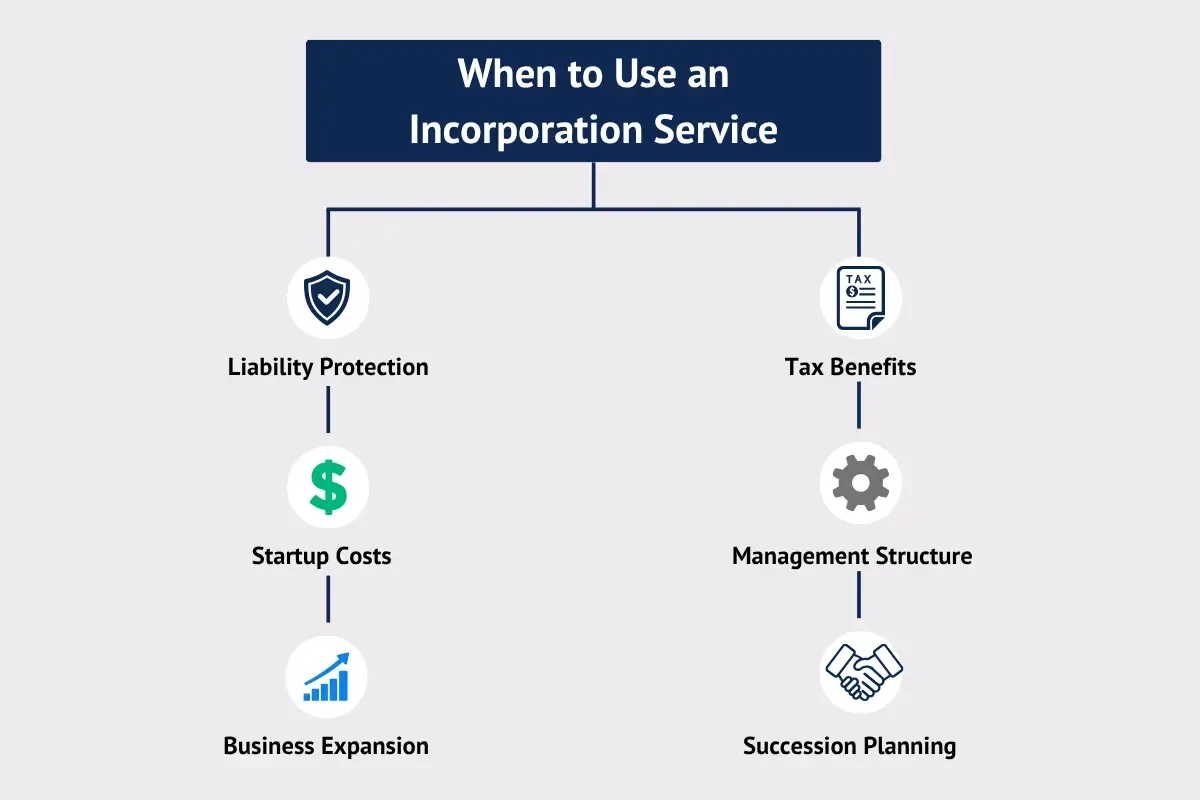
Incorporation services become valuable when professional incorporation assistance can save time and prevent errors. These services are especially helpful for launching a new business quickly and efficiently, ensuring all necessary steps are handled with expertise.
If You're Starting a Business for the First Time
First-time entrepreneurs often benefit from incorporation services due to unfamiliar legal filing procedures and complex state requirements.
To Ensure Accurate and Timely Filing
Incorrectly filed or delayed documents can result in rejection by state authorities and additional fees. Professional services ensure accurate document preparation and timely submission.
When You Need Help Choosing a Business Structure
Quality incorporation services can provide guidance or educational resources on selecting between an LLC, corporation, or other entity based on your specific goals and needs.
To Save Time and Focus on Launching the Business
Professional incorporation services handle the administrative burden, allowing you to focus on revenue-generating activities and customer acquisition.
Can One Service Provide Both Functions?
Many incorporation services also offer registered agent services, among other useful business services, providing a convenient one-stop solution for business formation and ongoing compliance needs. This bundled approach can save business owners time, money and effort while simplifying vendor relationships. When considering bundled services, look for providers that offer comprehensive packages with transparent pricing and strong customer support.
Ready to Start Your Business the Right Way?
Your business idea is solid, and your plan is in place. Now you're ready to officially launch your company, but you want to do it the right way. Building your business's legal foundation will help protect and support your venture for years to come. Registered agents serve as your business's reliable point of contact for legal documents and government correspondence, ensuring you never miss critical deadlines that could jeopardize your company's good standing. Incorporation services transform your concept into a legally recognized entity, handling the complex paperwork and state requirements that establish your business properly from day one.
These aren't just administrative tasks you can put off or handle casually. The decisions you make about your business structure and ongoing compliance support will impact everything from your tax obligations to your personal liability protection. While some entrepreneurs consider handling these responsibilities themselves to save money, understanding the risks of serving as your own registered agent reveals why professional services often provide better value and protection in the long run.
Take time to honestly assess your business needs, your available time, and your comfort level with handling compliance complexity. The right combination of professional services creates a solid foundation that lets you focus on what you do best—growing your business and serving your customers.
FAQs
Disclaimer
This content is intended for general educational and informational purposes only and does not constitute legal, tax, or accounting advice. Every effort is made to keep the information current and accurate; however, laws, regulations, and guidance can change, and no representation or warranty is given that the content is complete, up to date, or suitable for any particular situation. You should not rely on this material as a substitute for advice from a qualified professional who can consider your specific facts and objectives before you make decisions or take action.
Stay Informed!
Sign up to receive important updates, helpful resources, and special offers.