


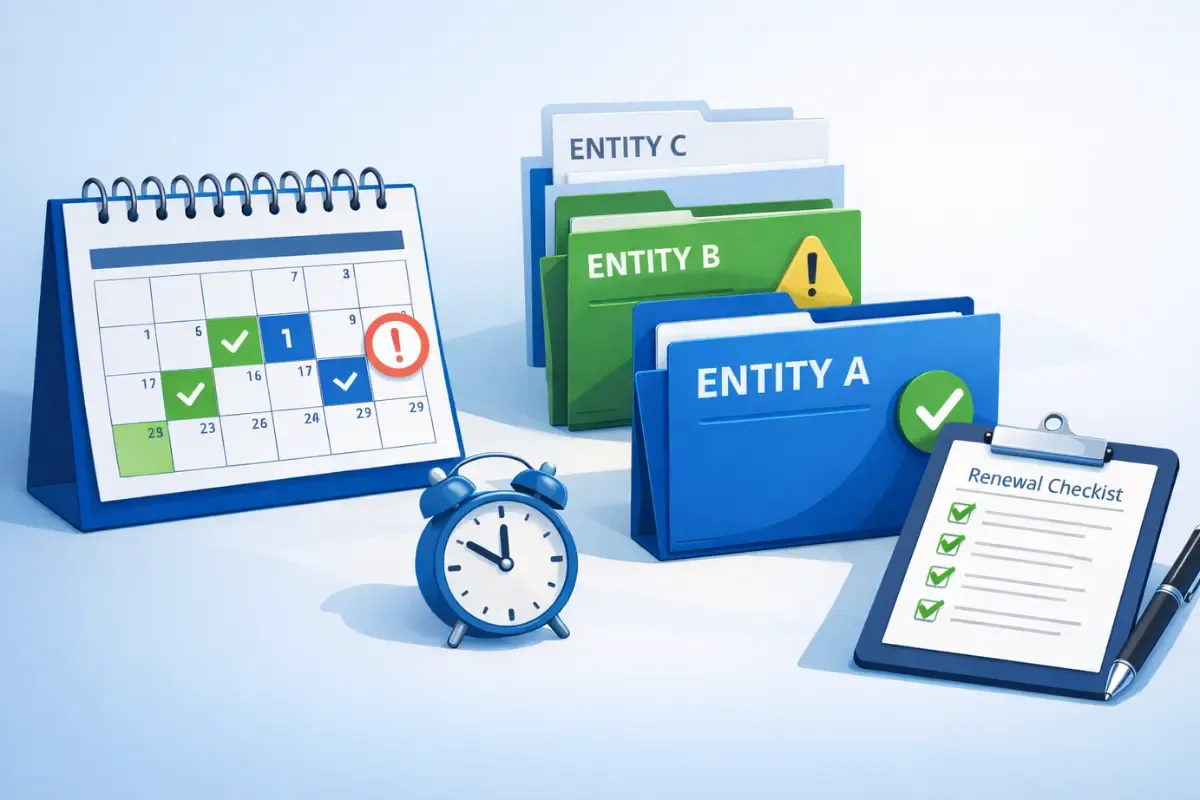
Have renewal deadlines ever caught you by surprise? For business owners managing multiple entity registrations across different states, keeping track of renewal dates, filing requirements, and compliance obligations can feel overwhelming.
In Colorado alone, Q4 2022 business entity renewals totaled approximately 171,210, a 2.9% year-over-year increase. These numbers illustrate just how many businesses are juggling renewal obligations—and how easy it is for deadlines to slip through the cracks.
Missing a renewal deadline can result in administrative penalties, loss of good standing, or even involuntary dissolution. With proper organization and tracking systems, such as InCorp Services' Entity Management System, businesses can handle renewals efficiently and maintain continuous compliance.
This guide provides practical strategies for managing multiple entity renewals and implementing automated tracking systems that ensure you never miss a critical deadline.
Key Takeaways
Centralizing all entities and renewal data in a single system (spreadsheet, database, or entity management platform) is the foundation for avoiding missed deadlines and maintaining continuous good standing.
Automated, multi-stage reminders and calendar integrations (email, Google Calendar, Outlook) dramatically reduce the risk of late filings by surfacing deadlines where teams already work.
Clear assignment of responsibility for each entity or renewal type, supported by written processes and templates, makes the renewal workflow scalable and resilient during staff changes.
Maintaining organized, long-term records of filings, confirmations, and good standing status supports audits, financing, and due diligence, while helping quickly resolve any discrepancies with state records.
Periodic reviews and audits of your tracking system (at least quarterly, plus deeper annual checks) ensure new entities are added, deadlines remain accurate, and potential compliance gaps are identified early.
Dedicated entity management solutions like InCorp’s Entity Management System and EntityWatch provide automated deadline monitoring, status alerts, and SOS-database monitoring that reduce manual workload and help prevent loss of good standing
Understand the Types of Renewals for Your Entities
Different business entities face varying renewal requirements depending on entity type, jurisdiction, and license type.
Annual reports represent the most common obligation. Most states require LLCs and corporations to file annual or biennial reports confirming business information remains current. Filing deadlines vary by state.
Business licenses and permits require regular renewal. General business licenses typically renew annually. Professional licenses for regulated industries may have different renewal cycles.
DBA registrations expire after set periods. Some states require DBA renewals every five years. Failure to renew can result in loss of the right to use that business name.
Foreign qualification registrations must be maintained through regular filings. When a business formed in one state operates in another, it registers as a foreign entity requiring ongoing annual reports.
Franchise taxes recur annually in many states. Understanding your entity portfolio helps identify all applicable obligations.
For guidance on establishing entities, see "Choosing a Formation Service."
Create a Centralized Renewal Tracking System
Having a single system to track all entities, deadlines, and documents transforms renewal management from reactive scrambling to proactive planning.
A centralized entity renewal calendar is designed to capture the following key data: entity name and state, renewal type, jurisdiction, renewal dates and expiration dates, filing fees, responsible person, and current status.
Spreadsheet-based systems work well for businesses with fewer than ten entities. Tools like Google Sheets allow customizable tracking accessible to multiple team members.
Database solutions offer more robust functionality for managing larger entity portfolios, with automated reminders and document storage integration.
Dedicated entity management systems represent the best tools for tracking corporate entity renewals, offering automated deadline monitoring, secure document storage, compliance calendar integration, and status dashboards.
According to the Department of Justice, training entity management resources and proper systems reduces administrative burden and improves compliance management. Understanding how to manage multiple LLC annual filings efficiently requires systematic tracking across all jurisdictions where your entities operate.
Set Up Automated Digital Reminders and Calendar Integration
Automated renewal reminders represent important steps to avoid missing business license deadlines by ensuring critical dates receive attention before they arrive.
Multi-stage reminder systems provide escalating alerts: 90 days, 60 days, 30 days, 14 days, and 7 days before expiration.
Calendar integration ensures reminders appear in the tools team members use daily. Syncing renewal dates with Google Calendar or Outlook makes deadlines visible. Color-coding renewals by urgency improves quick scanning.
Email notifications supplement calendar reminders. Alerts should include entity name, renewal type, deadline date, and filing fee.
Entity management platforms include built-in reminder functionality that automatically generates alerts based on renewal dates.
Understanding how to choose the right registered agent helps identify providers offering comprehensive notification support.
Automated reminders provide sufficient lead time for renewal conversations, information gathering, and filing completion without pressure.
Maintain Accurate Records and Documentation
Comprehensive documentation provides proof of compliance, supports audit trails, and enables quick resolution of questions about filing status.
Keep complete records for every renewal: filed reports, payment confirmations, state acceptance confirmations, certificates of good standing, and correspondence with state agencies.
Organize records by entity and year. Key tips for centralizing business compliance records include using a structure such as "Entity Name > Year > Document Type" to locate records quickly. Digital systems with search functionality streamline retrieval.
Retention policies should specify document lifespan. Formation documents require permanent retention. Annual reports typically require seven-year retention.
Secure storage protects sensitive information. Cloud-based platforms provide encrypted storage with access controls.
Version control tracks document changes and identifies who made updates.
Entity management systems include secure document storage integrated with renewal tracking.
Assign Roles and Responsibilities
Clear accountability helps ensure renewal tasks don't fall through the cracks.
Designate specific individuals responsible for each entity or renewal type. Assignment options include dividing by state, business unit, or renewal type. Effective organizing of renewal dates for multi-state companies requires a clear assignment of responsibilities across different jurisdictions.
Document responsibilities in writing. A responsibility matrix should specify who is responsible for monitoring deadlines, gathering information, approving filings, handling payments, and verifying completion.
Cross-training prevents single points of failure. Training backup personnel ensures continuity during absences.
Collaborative platforms allow secure access with role-based permissions.
For systematic approaches, review the best compliance tools for organized compliance management.
Monitor Regulatory Updates and State Requirements
Regulatory requirements change over time. States modify filing deadlines, adjust fees, update forms, and introduce new obligations. Staying informed helps reduce the risk of compliance failures.
Subscribe to official updates from states where your entities operate. Most Secretary of State offices offer email newsletters announcing regulatory changes.
Professional associations often summarize regulatory changes. Trade association newsletters can alert you to changes across multiple jurisdictions.
Registered agent services typically notify clients of regulatory changes. Professional agents monitor rule changes across all operating states.
Periodic review of state websites confirms current requirements. Quarterly visits help verify filing procedures haven't changed.
To understand why compliance management matters, read why business compliance is essential to overall growth.
Conduct Periodic Audits of Your Renewal System
Regular audits help verify your tracking system remains accurate and effective.
Quarterly audits should verify that all active entities are in the system, that renewal dates are current, that completed renewals are documented, that missed deadlines are identified, and that upcoming renewals within 90 days are reviewed.
Annual audits go deeper. Request certificates of good standing to verify that state records match internal data. Review entity listings to identify any that should be dissolved.
Audit trails help identify how discrepancies arose. Systems that log changes with timestamps make it easier to trace incorrect information.
Documented audit procedures ensure consistent reviews. A written checklist specifies what to verify and what actions to take when issues are discovered.
Use Visual Tools to Prioritize Renewals
Visual representation helps identify urgent deadlines and allocate resources effectively.
Color-coding creates an instant hierarchy: red for renewals due within 30 days, yellow for 31-60 days, green for 61-90 days, and blue for 90+ days.
Dashboard views provide an at-a-glance status. Summary tiles show the total number of tracked entities, renewals completed, renewals pending, and entities not in good standing.
Kanban boards track renewals through stages: upcoming, in progress, submitted, and completed.
When managing dozens of entities, visual tools help prioritize attention where needed.
Create Templates for Recurring Renewals
Standardization reduces errors and saves time.
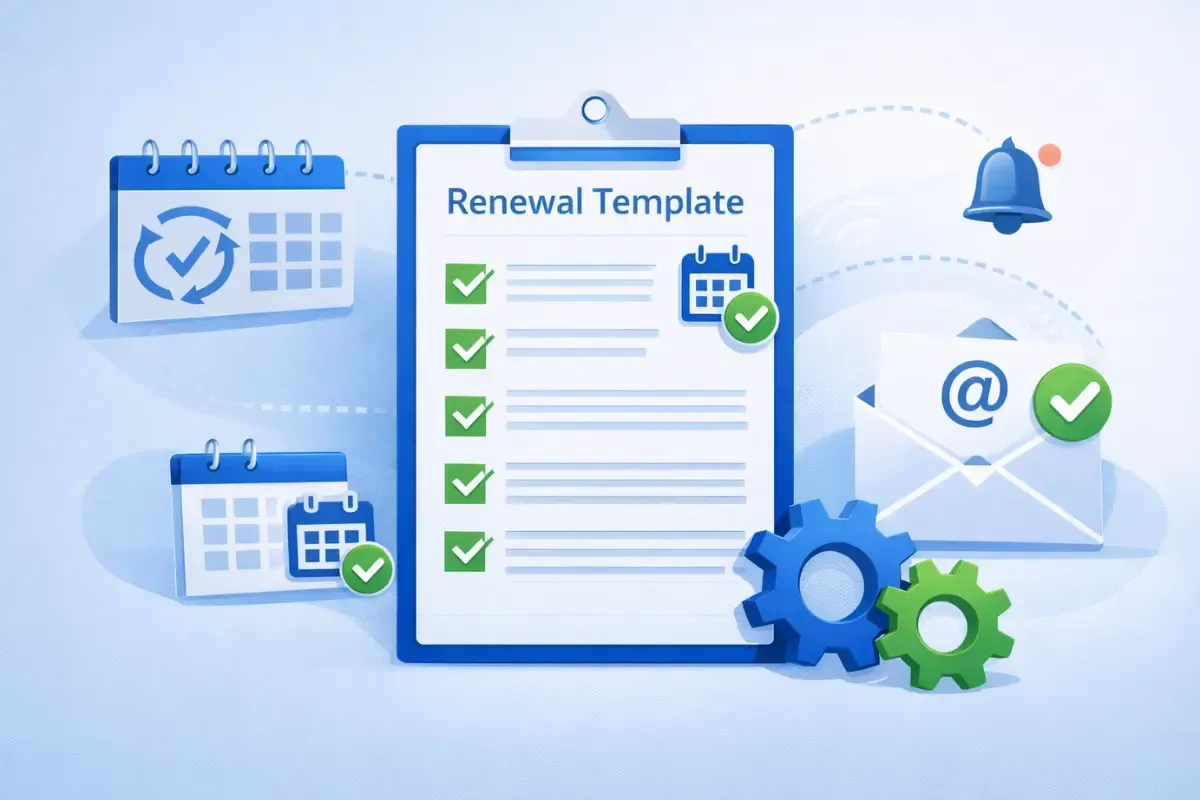
Form templates pre-populate standard information. Templates that include the entity name, registered agent information, and officer details reduce data entry and prevent errors.
Email templates streamline communications. Standard emails for renewal notifications, payment requests, and filing confirmations ensure consistent communication.
Checklist templates ensure no steps are skipped: verify the deadline, gather information, complete the form, obtain approval, submit payment, file the renewal, and confirm acceptance.
Process documentation creates reusable workflows, helping new team members learn quickly.
For systematic approaches, see entity management systems.
Plan for Contingencies and Minimize Errors
Planning for contingencies works to prevent disruptions don't cascade into compliance failures.
Backup strategies address common scenarios. Cross-training provides backup coverage. Understanding reinstatement procedures enables quick recovery. Maintaining backup payment methods prevents delays.
Regular system reviews verify automation is working. Periodic verification that alerts are being delivered and stakeholders are responding prevents silent failures.
Building buffer time allows catching errors before deadlines. Completing renewals 5 days before deadlines provides a cushion for addressing issues.
Leveraging human oversight and automated tools creates redundancy.
Stay Organized and Never Miss a Renewal
Managing multiple entity renewals doesn't have to be overwhelming. With centralized tracking systems, automated reminders, clear responsibilities, and systematic processes, businesses can maintain compliance efficiently across all jurisdictions.
Establish proactive systems before facing urgent deadlines. Consolidate all entity information into a single tracking system. Add automated reminders that provide adequate lead time for preparation and filing. Document transparent processes and assign specific responsibilities to team members. Conduct regular audits to verify that nothing is missed.
InCorp's Entity Management System is among the leading software solutions for tracking entity renewal deadlines, offering comprehensive tools for multi-entity tracking, including centralized entity data storage, automated deadline monitoring and alerts, secure document management, compliance calendar integration, and real-time status dashboards. InCorp's EntityWatch® service monitors Secretary of State databases in most states, compares official records with your data, and alerts you to any discrepancies that could affect your good standing.
Professional support reduces administrative burden while improving compliance reliability.
Ready to simplify multiple entity renewal tracking? Contact InCorp to learn how our Entity Management System and registered agent services can help you stay organized and compliant.
FAQs
Disclaimer
This content is intended for general educational and informational purposes only and does not constitute legal, tax, or accounting advice. Every effort is made to keep the information current and accurate; however, laws, regulations, and guidance can change, and no representation or warranty is given that the content is complete, up to date, or suitable for any particular situation. You should not rely on this material as a substitute for advice from a qualified professional who can consider your specific facts and objectives before you make decisions or take action.
Stay Informed!
Sign up to receive important updates, helpful resources, and special offers.