


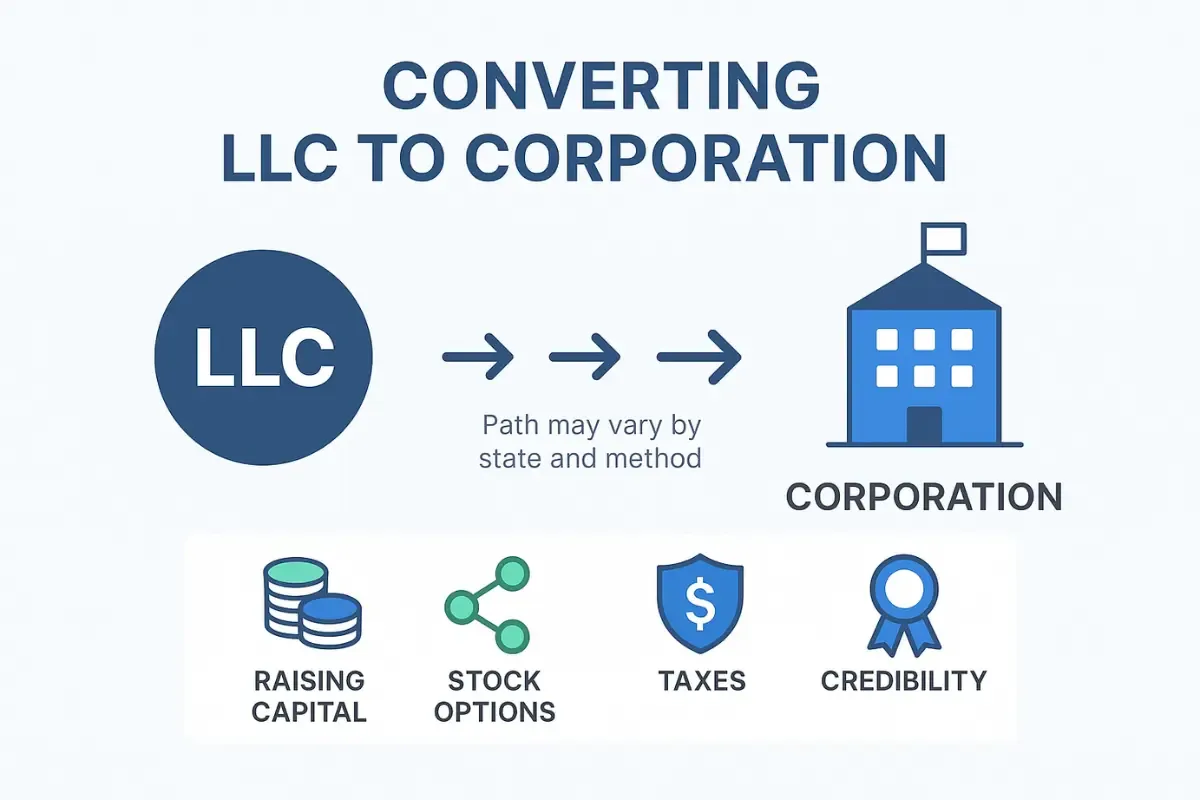
Deciding to convert an LLC to a corporation is a significant strategic move for growth, often to attract venture capital, offer stock options, or qualify for Qualified Small Business Stock (QSBS) tax benefits. However, the process is not a simple formality. The steps, costs, and even available methods depend heavily on your state’s laws. Navigating this complex LLC conversion process requires careful attention to detail to manage potential risks, such as rejected filings and unexpected tax consequences. This guide outlines the three main methods for LLC conversion and the essential post-conversion checklist.
Key Takeaways
Converting an LLC to a corporation is a strategic move providing greater access to venture capital, stock options, and valuable tax benefits like Qualified Small Business Stock (QSBS), but comes with added compliance and tax complexity.
Three conversion methods exist: statutory conversion (the simplest if available in your state), statutory merger (which requires forming a new corporation and merging the LLC), and non-statutory asset transfer (a last resort, involving manual asset and contract assignments).
Choose your method based on state law and business needs: Most startups prefer statutory conversion or merger to preserve continuity, allow for stock issuance, and ensure clean transfer of assets and liabilities.
Post-conversion compliance is critical: Corporations must set up bylaws, appoint a board, issue stock, update contracts and business licenses, and fulfill ongoing IRS and state filing requirements to maintain legal protection and status.
Risks and mistakes can disrupt the process: Failing to obtain proper member approval, using incorrect forms, or overlooking contract and tax assignments can lead to delays, legal exposure, and lost tax opportunities.
LLC-to-Corporation Conversion — The Basics
Think of this conversion as a legal rebranding of your company’s core business structure. Instead of dissolving your Limited Liability Company and starting over, you transform it into a corporation, which can preserve your business history, EIN, and existing contracts. This continuity is the primary advantage over starting from scratch.
The core difference lies in structure and taxation. You're moving from a member-managed LLC with flexible ownership to a more formal hierarchy with shareholders, a board of directors, and issued stock. Critically, you're also shifting from LLC pass-through taxation to a corporate tax structure.
Business owners face several critical decisions when converting, including whether to elect S corporation tax treatment after forming their corporation. All corporations are formed at the state level as standard corporations, which default to C corporation tax status with the IRS. These C corporations face double taxation (corporate income tax and shareholder tax on dividends), but have no restrictions on ownership or the number of shareholders, and can issue multiple classes of stock. Corporations can elect S corporation tax treatment by filing IRS Form 2553, which provides pass-through taxation similar to an LLC. However, S corporation election comes with restrictions: the corporation is limited to 100 shareholders, all of whom must be U.S. citizens or residents, and can generally issue only one class of stock.
Three Ways to Convert
There are three primary methods to change your business structure. The best path for you depends entirely on your state’s statutes.
Statutory Conversion
Business owners have several options for changing their company’s legal structure, but statutory conversion is often the most straightforward method. This approach lets you convert from an LLC to a corporation without dissolving your old entity or forming a new one, saving time and reducing complexity.
Statutory conversion is often the most straightforward method. With a single filing—a Certificate of Conversion—your LLC officially becomes a corporation. The state automatically transfers all assets, liabilities, and your company's good standing. It is often the fastest and most cost-effective path if your state offers it. The availability of statutory conversion is entirely state-dependent; several states—including California, Texas, and Delaware—have established guidelines for this approach. For example, the California Secretary of State provides specific guidelines for this process.
This type of conversion is popular with startups and growing companies, as it preserves business continuity and avoids operational disruptions. However, the steps and requirements—including approval from company owners, drafting a formal plan of conversion, and filing supplemental documents—can vary according to each state’s statutes. Consulting state guidelines and legal counsel is recommended to ensure all formalities are met and the process is completed smoothly.
Statutory Merger
Statutory merger is a common alternative when a direct conversion isn't available. In this process, you incorporate a new corporation and legally merge your existing LLC into it. The LLC ceases to exist, and the corporation assumes all the LLC’s assets and liabilities. While more complex than statutory conversion, statutory merger requires a formal merger agreement and approvals from LLC members and the new corporation’s shareholders, providing a clear, state-sanctioned transfer of assets and liabilities.
This option is often chosen for the following reasons:
State restrictions: In many states, direct statutory conversion between LLC and corporation is not permitted, making merger the only viable legal pathway.
Investor requirements: Venture capitalists and institutional investors typically invest only in corporations, not LLCs, requiring startups to convert to a corporation for fundraising.
Equity compensation: Corporations allow for more flexible stock option plans and equity incentives for employees, which LLC structures do not readily support.
Operational flexibility and ownership changes: Corporations enable more flexible ownership structures and easier transferability of equity, positioning the business for growth, complex acquisitions, or public offerings.
Tax strategy: Merging into a corporation may offer tax advantages for business owners or investors, such as qualifying for Section 1202 QSBS tax treatment or changing entity-level tax status.
Steps Involved
The statutory merger process typically involves:
Forming a new C corporation
Preparing a formal merger plan and securing member approval
Filing a Certificate of Merger with the state
Exchanging LLC membership interests for corporation stock
Dissolving the LLC after the merger is complete
Notifying third parties and updating business materials to reflect the corporation’s new status
Statutory merger is more involved but ensures a comprehensive, legally clean transfer of assets, offering structural advantages for growth-stage businesses or those seeking investment and expanded operations.
Non-Statutory Merger / Asset Transfer
Non-statutory merger—also known as an asset transfer—is typically viewed as a last resort when statutory options are unavailable. This approach requires forming a new corporation and manually transferring, one by one, all assets, contracts, intellectual property, leases, and liabilities from the old LLC to the new entity. Each asset and contract must be assigned or sold by a specific agreement, often requiring the consent of landlords, lenders, or clients, which can significantly increase complexity and legal costs.
Non-statutory merger LLC is often considered a last resort. This method involves a complete asset transfer of an LLC to a corporation: you form a new corporation and then manually sell or assign every single asset, contract, and liability from the old LLC. The complexity can be significant, requiring individual reassignments of leases, intellectual property, and client contracts. This method can be more complex due to potential tax complications and missed obligations.
This process might be unavoidable if your state doesn’t allow statutory conversion or merger, or if specific contracts, business licenses, or property titles require express assignments rather than automatic transfers. Each assignment or transfer may require new approvals or negotiations, potentially exposing your business to lapses in rights or obligations during the transition. The manual nature of this process can also create additional tax reporting needs, generate unintended tax consequences, and increase the risk of overlooking important items. Because of these challenges, business owners should proceed with caution and consult legal and tax professionals before undertaking a non-statutory asset transfer.
Should You Convert? Pros & Cons
Converting is a significant decision. Weigh these advantages and disadvantages carefully.
Reasons to Convert
Advantage | Why It Matters |
|---|---|
Access to Capital | Venture capital firms and angel investors overwhelmingly prefer investing in C-Corporations. Many won't even consider LLCs due to tax complications their limited partners face. Converting removes this barrier to institutional funding. |
Stock & Equity | Corporations can issue multiple stock classes with different voting rights and preferences, attracting sophisticated investors. They also enable straightforward stock option plans that help recruit talented employees who expect equity compensation. |
QSBS Eligibility | Qualified Small Business Stock provisions allow shareholders to exclude up to 100% of capital gains when they sell their shares, potentially saving millions in taxes. This benefit only applies to C-Corporation stock, not LLC interests. |
Structured Growth & Ownership | Corporate frameworks facilitate adding new owners through stock issuance and enable clean share transfers that don't require amending organizational documents or getting everyone's signature. |
Enhanced Credibility | The "Inc." designation signals established business practices to partners, clients, and investors. While your LLC's substance matters most, corporate status opens certain doors automatically. |
Potential Drawbacks
Drawback | The Reality Check |
|---|---|
Increased Compliance | Corporations require annual shareholder meetings, detailed meeting minutes, formal resolutions for major decisions, and rigorous record-keeping. The formalities that protect your limited liability also create ongoing administrative work. |
Higher Costs | State filing fees for corporations often exceed LLC costs. Many states impose franchise taxes on corporations. Professional fees for corporate compliance typically run higher than LLC maintenance. |
Double Taxation (C-Corp) | C-Corporation profits face taxation at the corporate level (currently 21% federal rate), then shareholders pay taxes again on dividends they receive. This double taxation can significantly reduce overall returns compared to pass-through treatment. |
Strict Formalities | Courts can "pierce the corporate veil" and expose shareholders to personal liability if you fail to maintain proper corporate formalities. The protection isn't automatic—you must earn it through consistent compliance. |
Statutory Conversion
A statutory conversion LLC to a corporation is often the most efficient path if your state allows it. It provides a clean, state-sanctioned title transfer for your entire business without the need to dissolve the LLC first.
Step-by-Step Checklist
Review the Operating Agreement: Check your LLC’s operating agreement for any clauses that govern conversion.
Secure Member Approval: Most states require a unanimous or majority vote from LLC members.
Select Corporation Type & Name: Choose between a C-Corp or S-Corp and ensure your desired name is available.
Draft a Plan of Conversion: This document outlines the terms and conditions of the conversion.
File Conversion Documents: Prepare and file the Articles of Incorporation and a Certificate of Conversion with your state.
Receive Stamped Copies: Wait for the state to process and return approved documents.
Complete Post-Conversion Setup: Adopt corporate bylaws, issue stock, and hold an initial board meeting.
The simplicity of statutory conversion depends on precise execution. One missed signature or incorrect form can lead to rejections and delays.
Statutory Merger
A statutory merger is a standard alternative when direct conversion isn't available in your state. This process generally involves forming a new corporation and legally merging your existing LLC into it, with the LLC ceasing to exist and the corporation assuming all its assets and liabilities. A statutory merger is a standard alternative when direct conversion isn't available in your state. According to the Corporate Finance Institute, this process generally involves forming a new corporation and legally merging your existing LLC into it, with the LLC ceasing to exist and the corporation assuming all its assets and liabilities.
Step-by-Step Checklist—General Guide
Review the Operating Agreement: Check for any provisions regarding mergers or changes to the business structure.
Form the New Corporation: File Articles of Incorporation with your state to create the receiving corporation.
Draft a Merger Agreement: Create a formal document outlining the merger terms, including asset transfers and conversions of members to shareholders.
Secure Member and Board Approval: Obtain required votes from LLC members and the new corporation's board of directors.
File Merger Documents: Submit Articles of Merger or Certificate of Merger with your state, along with any required attachments.
Wait for State Approval: Allow time for processing and receive stamped approval documents.
Complete Post-Merger Requirements: Dissolve the LLC if not automatically terminated, transfer licenses and permits, and notify creditors and business partners of the change.
The merger process requires careful coordination between the two entities. Missing approvals or improperly drafted agreements can create significant delays or legal complications.
Non-Statutory Merger / Asset Transfer
This administrative approach becomes necessary when neither statutory conversion nor merger is available in your state. In this scenario, a new corporation is formed, and each asset, contract, and liability from the LLC must be manually transferred to the new entity.
Step-by-Step Checklist—General Guide
Create the New Corporation: File Articles of Incorporation to establish your corporation.
Document All LLC Assets: Create a comprehensive inventory of assets, contracts, licenses, and liabilities.
Draft Transfer Agreements: Prepare bills of sale, assignment agreements, and assumption documents for each asset category.
Execute Individual Transfers: Assign intellectual property, transfer real estate titles, reassign leases, and migrate bank accounts.
Notify All Stakeholders: Contact vendors, customers, and creditors about the entity change and new tax ID number.
Update Licenses and Permits: Apply for new business licenses under the corporation's name.
Dissolve the LLC: File Articles of Dissolution once all assets are successfully transferred.
This manual transfer process demands meticulous attention to detail. Each overlooked asset or contract can create future disputes or tax complications, making professional guidance particularly valuable for this method.
Post-Conversion Compliance To-Dos (Don’t Skip These)
The filing is just the beginning. Corporations have ongoing compliance requirements to maintain their status and limited liability protection.
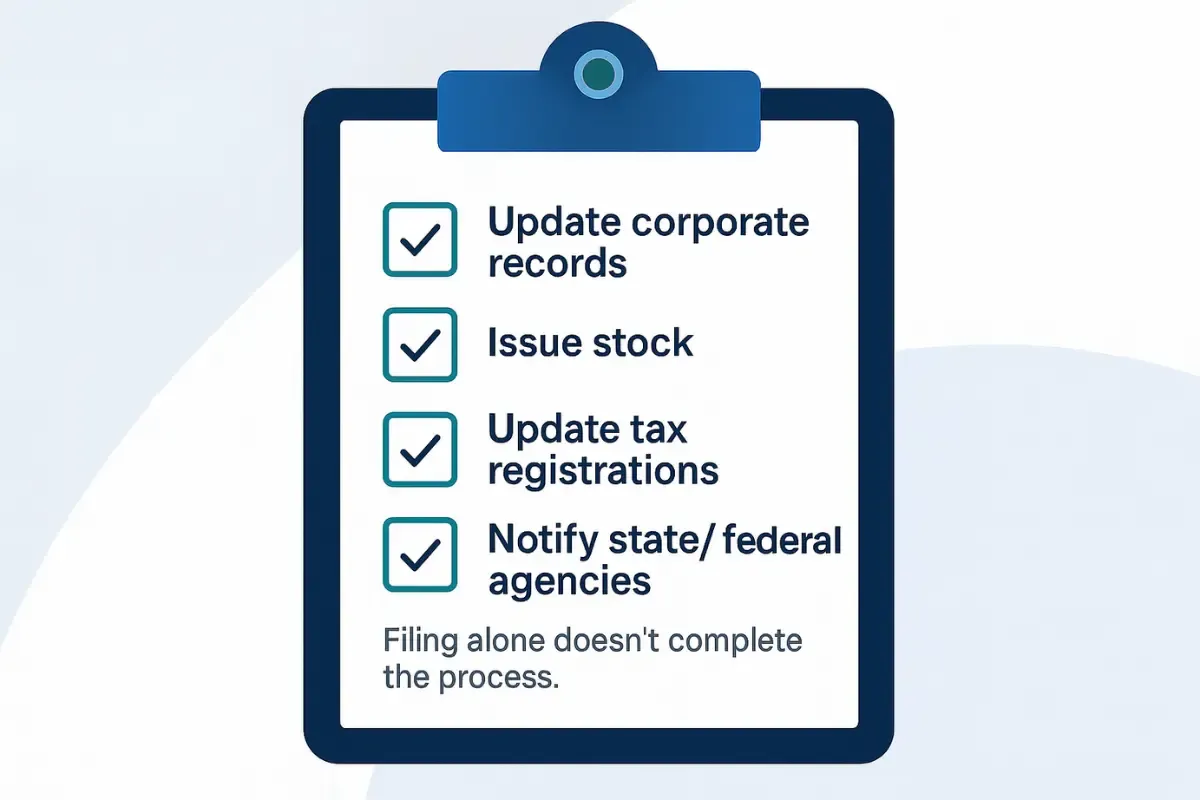
Corporate Governance Setup
Draft and adopt corporate bylaws.
Appoint a Board of Directors and hold an initial meeting.
Issue stock certificates to shareholders.
Set up a system for maintaining corporate minutes and records. Adhering to consistent document retention guidelines is a key part of this process.
IRS & Tax Steps
This is an area where precision is important. The conversion itself may have tax implications, and updating your IRS tax classification is a key step, subject to specific agency rules.
Apply for a new EIN if the IRS requires it.
If electing S-Corp status, file Form 8832 and Form 2553 with the IRS within the required deadlines.
Consult a tax advisor or refer to IRS guidelines to understand the tax consequences of converting an LLC to an Inc.
Contracts, IP & UCC Filings
This final step ensures all your legal and financial agreements are correctly tied to the new entity.
Formally assign all existing contracts (leases, vendor agreements, client agreements) to the corporation.
Re-title intellectual property (patents, trademarks) under the corporation’s name.
Re-file UCC-1 financing statements to perfect security interests under the new corporate name. Understanding the purpose of UCC filings is important for maintaining secured party rights.
Banking, Payroll, Insurance
Open a new corporate bank account or update your existing one.
Re-establish payroll and benefits under the new corporate entity.
Update business insurance policies to reflect the new corporate name.
Timeline & Costs — What to Expect
A straightforward statutory conversion typically takes 4-8 weeks, depending on the state's processing times. More complex mergers or asset transfers can take several months to complete.
Plan your resources carefully:
State Filing Fees: $50-$500+ for conversion and incorporation documents.
Legal & Accounting Fees: Costs for professional guidance can vary.
New Licenses & Permits: Variable costs.
Potential Tax Implications: Consultation with an advisor is common.
Common Mistakes to Avoid
Skipping Member Approval: Failing to secure the proper vote can create legal challenges.
Misfiling Documents: Using the wrong forms or making errors are common causes of rejection.
Ignoring Contract Assignments: Failing to assign contracts can leave the old LLC exposed to liability.
Overlooking Tax Implications: Failing to file Form 8832 correctly can result in complications.
Final Thoughts: Make the Move the Right Way
Converting your LLC to a corporation is a defining strategic step for scaling your business—whether your goal is to secure venture capital, issue stock options, or qualify for significant tax benefits like QSBS.
While the rewards are great, the process demands precision and professional guidance to manage the complex legal, compliance, and tax shifts. One misstep, whether it's an incorrect statutory filing or an overlooked post-conversion formality, can jeopardize your new corporate veil and liability protection.
The most crucial step is not the paperwork—it's the planning.
Your Professional Advisory Checkpoint: Before you initiate any state filing, if unsure, you should consult with an experienced Attorney to structure the legal conversion and an expert CPA or Tax Advisor to ensure you maximize benefits and correctly manage the substantial tax implications.
Once your legal and tax professionals have charted the optimal course, let us help handle the accurate execution.
FAQs
Disclaimer
This content is intended for general educational and informational purposes only and does not constitute legal, tax, or accounting advice. Every effort is made to keep the information current and accurate; however, laws, regulations, and guidance can change, and no representation or warranty is given that the content is complete, up to date, or suitable for any particular situation. You should not rely on this material as a substitute for advice from a qualified professional who can consider your specific facts and objectives before you make decisions or take action.
Stay Informed!
Sign up to receive important updates, helpful resources, and special offers.